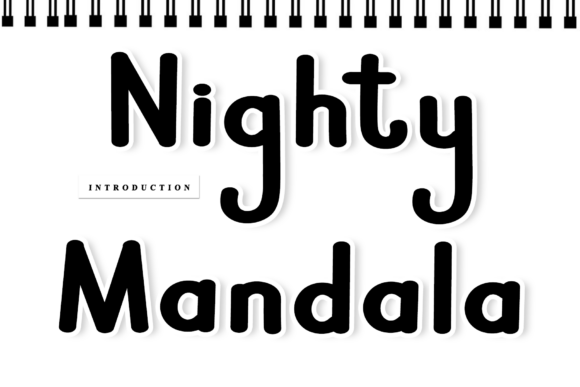
Nighty Mandala: A Practical Look at This Handwritten Font for Modern Design
In the search for a typeface that conveys warmth, personality, and a handcrafted quality, designers and creators often find themselves sifting through countless options. The goal is to find a font that feels authentic without sacrificing legibility or versatility. Nighty Mandala enters this space as a handwritten font designed to offer a distinct aesthetic. It positions itself as a tool for creating eye-catching logos, branding materials, and typographic quotes. This analysis will explore its core characteristics, practical applications, and the specific scenarios where it may prove most valuable, providing a balanced perspective for professionals considering it for their projects.
Understanding the Core Identity of Nighty Mandala
At its foundation, Nighty Mandala is a script font characterized by its fluid, connected letterforms and a natural, handwritten rhythm. The name itself hints at a dual nature: the casual, personal feel of "nighty" or night-time comfort, and the intricate, decorative quality of a "mandala." This combination suggests a typeface that is both approachable and detailed. Each letter is crafted with unique touches, aiming to replicate the subtle inconsistencies and flow of actual handwriting. This design philosophy moves away from the mechanical perfection of sans-serifs or the rigid structure of traditional serifs, offering a more human and organic visual voice.
The font's primary purpose is not for setting long blocks of body text. Instead, it is engineered for display use—headlines, logos, pull quotes, and other prominent typographic elements where its expressive qualities can be fully appreciated. Its strength lies in its ability to inject immediate personality into a design. For a small business owner creating a brand identity, a freelancer designing a client's wedding invitation, or a blogger crafting a featured image, Nighty Mandala provides a tool to establish a specific mood quickly. The practical value is in its capacity to make a design feel more bespoke and less generic, which can be crucial for standing out in a crowded visual landscape.
Key Characteristics and Design Analysis
Evaluating a handwritten font requires looking beyond initial appeal to assess its functional qualities. Nighty Mandala presents several notable characteristics that define its usability.
Legibility and Readability: For a script font, legibility is paramount. Nighty Mandala's letterforms, while stylized, generally maintain clear distinctions between characters, which helps in reading short phrases at a glance. However, as with most expressive scripts, its readability decreases significantly with smaller sizes or longer sentences. It is best suited for headlines of a few words to a short sentence. Testing it in context is essential; a word that looks elegant in a mockup might become ambiguous in a final logo where clarity is critical.
Versatility and Pairing: The font's decorative nature means it rarely works well in isolation for a complete project. Its real power emerges in thoughtful pairing. Nighty Mandala pairs effectively with clean, simple sans-serif fonts like Montserrat, Lato, or Open Sans. The contrast allows the handwritten script to stand out for headlines while the sans-serif handles the body text, ensuring overall legibility and visual hierarchy. It can also complement minimal serif fonts for a more classic, refined aesthetic. The key is to use it as an accent, not the primary workhorse.
Character Set and Features: A professional font's value is also in its technical completeness. Does Nighty Mandala include a full set of punctuation, numerals, and accented characters for international use? Does it offer stylistic alternates or ligatures to enhance its handwritten feel and prevent repetitive patterns? These features significantly impact its flexibility. A robust character set allows it to be used in diverse contexts, from English-language branding to multilingual projects. Designers should review the font's specimen sheet to understand exactly what glyphs and OpenType features are available.
Practical Applications and Real-World Use Cases
The true test of any creative asset is its performance in practical scenarios. Nighty Mandala finds its most effective use in specific, targeted applications.
Branding and Logo Design: This is arguably its strongest suit. For brands aiming for a personal, artisanal, or feminine aesthetic—think boutique shops, handmade goods, lifestyle blogs, or beauty services—Nighty Mandala can form the core of a logo. Its unique letterforms help create a memorable and distinctive mark. However, designers must ensure the logo remains scalable and legible across various sizes, from a website header to a small social media avatar. Sometimes, simplifying or customizing certain letter connections may be necessary for optimal performance.
Marketing and Social Media Graphics: The font excels in creating visually engaging quotes, promotional banners, and Instagram story text. Its inherent personality captures attention in fast-scrolling feeds. For marketers and content creators, it offers a way to quickly add a layer of sophistication or whimsy to graphics without extensive design work. It is particularly effective for quotes, call-to-action phrases, or event titles where emotional resonance is more important than dense information delivery.
Editorial and Publication Design: In the context of magazines, book covers, or blog headers, Nighty Mandala can be used for chapter titles, pull quotes, or section headings. It adds a human, editorial touch that can break the monotony of standard typographic layouts. Educators creating materials or publishers designing cover art might use it to convey a sense of narrative or creativity. The limitation here is, again, scale; it should be reserved for large, isolated text elements.
Who Benefits Most and Situational Considerations
Nighty Mandala is not a universal solution, but for the right user and project, it can be highly effective.
Ideal Users: Entrepreneurs and small business owners launching a brand with a personal touch will find it particularly useful. Freelance graphic designers and social media managers looking to expand their toolkit with expressive display fonts will appreciate its aesthetic. Bloggers and content creators aiming to elevate their visual branding for quotes and headers are a natural fit. Its value is highest for those who need to communicate personality and warmth through their visual identity.
When to Exercise Caution: It is generally unsuitable for formal corporate branding, technical documentation, or any context requiring a neutral, authoritative tone. Its use in body text is not recommended. Projects targeting audiences that expect high modernity or minimalism might also clash with its handwritten style. Furthermore, its effectiveness depends heavily on the quality of its production—kerning (spacing between characters) and consistency across the character set are crucial. Poorly crafted script fonts can look amateurish.
Long-Term Value and Reliability: A font's long-term value lies in its technical quality and licensing. Is the font file well-constructed? Does it include proper licensing for commercial use? Will the font designer or foundry provide updates? These are practical considerations. A beautifully designed font with poor technical execution can cause frustration in a professional workflow. Therefore, sourcing Nighty Mandala from a reputable marketplace or foundry that provides clear documentation and support is as important as the design itself.
Final Assessment: Aligning the Font with Your Goals
Choosing a typeface like Nighty Mandala is a strategic decision. It is not merely about liking how the letters look in isolation, but about how well it serves the project's communication goals. Its strength is in its ability to convey authenticity, creativity, and a personal connection. If your project demands these qualities—whether for a new logo, a series of social media graphics, or an inviting editorial layout—it is a compelling option worth serious consideration.
The most prudent approach is to test it thoroughly within the context of your specific design. Create mockups to see how it interacts with your color palette, imagery, and other fonts. Evaluate its legibility at the intended sizes. By aligning its inherent character with your project's audience and objectives, you can determine if Nighty Mandala is the right tool to bring your design vision to life with a unique and beautiful touch. Its practical value is realized not in every project, but in those where its distinct personality becomes a meaningful part of the story you wish to tell.